
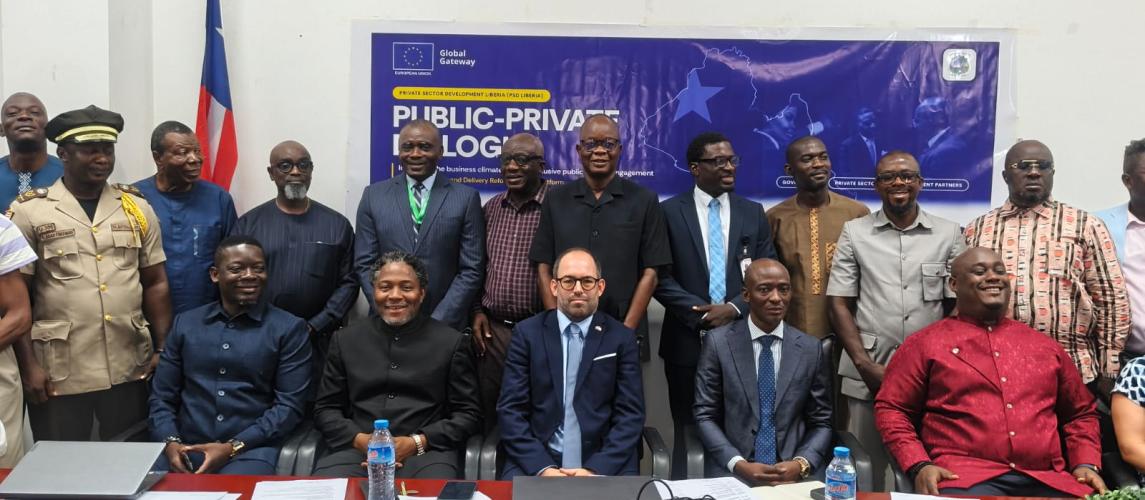
MoCI, Partners Launch Public-Private Dialogue to Advance Development
MONROVIA, LIBERIA — November 24, 2026 — The Ministry of Commerce and Industry (MoCI), in collaboration with international development partners, has launched a Public-Private Dialogue Workshop under the Private Sector Development (PSD) Liberia Supply Sector Development Programme. The initiative seeks to strengthen collaboration between government and private-sector stakeholders to promote economic growth and improve Liberia’s business environment.
The US$25 million programme, financed by the European Union (EU) and implemented by Expertise France, with the involvement of the International Labour Organization (ILO) and the International Finance Corporation (IFC), is designed to support private-sector development, strengthen supply chains, and create opportunities for sustainable economic growth.
Speaking on behalf of the Minister of Commerce and Industry, Hon. Stephen M. Yekeson, Jr., Deputy Minister for Administration, Hon. Tarnue N. Jeke, emphasized the importance of constructive engagement between government and private-sector stakeholders.
He reaffirmed the Ministry’s commitment to creating an enabling business environment through dialogue, partnership, and coordinated efforts to address challenges affecting businesses and the country’s supply sectors.
Hon. Jeke expressed appreciation to the EU, ILO, and IFC for their technical and financial support toward the engagement.
Addressing the issue of Liberianization, the Deputy Minister stressed that the policy should promote the meaningful participation of Liberians in the national economy through local ownership, entrepreneurship, investment, enterprise development, and job creation.
He noted that the successful implementation of the regulation requires clear legislation, institutional coordination, practical enforcement mechanisms, and an enabling business environment.
Hon. Jeke further called for a unified government approach involving the Ministries of Commerce and Industry, Justice, Labor, and Finance and Development Planning; the Liberia Revenue Authority; Liberia Immigration Service; National Investment Commission; and other relevant institutions.
According to him, the review process should establish clarity regarding reserved business activities, verification of Liberian ownership, enforcement responsibilities, compliance requirements, and appropriate penalties. He cautioned against creating unnecessary bureaucratic obstacles that could discourage investment or undermine fair competition.
Meanwhile, Deputy Minister for Commerce and Trade Services, Wilmot A. Reaves, called for sustained collaboration among government institutions, development partners, and private-sector actors to advance the implementation of Liberia’s Liberianization policy and create greater economic opportunities for Liberian businesses. He emphasized that discussions must continue beyond the workshop, noting that Liberia needs practical solutions to address longstanding challenges associated with implementing provisions of the Investment Act.
Deputy Minister Reaves stressed that meaningful Liberian participation in the national economy requires deliberate government action, particularly in strengthening the capacity of Liberian entrepreneurs to participate in supply chains, distribution, manufacturing, and other key areas of economic activity.
He noted that empowering local businesses to become active participants in the country’s economic ecosystem requires intentional policies, institutional support, and an enabling business environment.
Deputy Minister Reaves also expressed appreciation to the European Union, through Expertise France, for supporting the Private Sector Development Programme under which the dialogue was organized. He further acknowledged the contributions of the International Finance Corporation (IFC), the World Bank, and other development partners for their continued technical and institutional support.
He commended the Ministry of Finance and Development Planning, Governance Commission, Bureau of Concessions, Liberia Immigration Service, National Investment Commission, Liberia Revenue Authority, Liberia Business Registry, Liberia Agriculture Commodity Regulatory Authority (LACRA), and other government institutions for participating in the dialogue.
Also speaking, Mr. Gilles Matayron of the European Union Delegation to Liberia reaffirmed the EU’s commitment to supporting inclusive economic growth and strengthening dialogue between government and the private sector. He disclosed that the engagement forms part of the Public-Private Dialogue Work stream under the PSD Liberia Supply Sector Development Programme, a US$25 million initiative financed by the European Union and implemented by Expertise France.
Mr. Matayron emphasized that the process is government-owned, with development partners serving as facilitators to support constructive engagement and effective policy development. He observed that international experience demonstrates that reforms are more successful when governments engage businesses in meaningful dialogue, allowing private-sector concerns and operational realities to be considered during policy development.
For her part, the Head of Office of the International Finance Corporation (IFC) in Liberia, Ms. Korina Daniel, underscored the importance of sustained public-private partnerships in strengthening the country’s business environment. She stressed that economic reform should not be viewed as the responsibility of government alone, but as a shared undertaking requiring cooperation among public institutions, local businesses, micro, small, and medium-sized enterprises (MSMEs), and investors.
Ms. Daniel noted that private-sector participation would provide practical evidence of existing business constraints, investment opportunities, and the incentives needed to promote enterprise development.
She further highlighted the importance of policy predictability, trust, and investor confidence, emphasizing that meaningful dialogue must translate into measurable and time-bound reforms.
The engagement also comes ahead of the 2026 National MSME Conference and Trade Fair, scheduled for December 8–10, 2026, which will focus on the broader theme of Liberianization. The conference is expected to provide an additional platform for examining how Liberian entrepreneurs, particularly MSMEs, can benefit from opportunities created by the policy.
Jacob N.B Parley
Public Affairs Director
Ministry of Commerce & Industry
Emails: jacobtheancestor@yahoo.com/jacobnbparley1@gmail.com
Contacts: +231 777604576/886560455
WhatsApp: +231 881336136
